


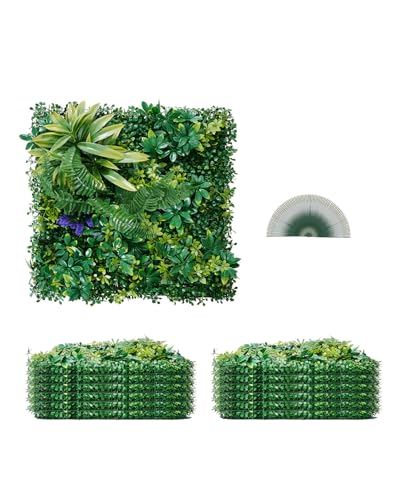
Artificial hedge
Artificial hedges – the ideal solution for you
An artificial hedge offers reliable protection from strangers all year round. They are also a real eye-catcher because they come in lush green. The thick artificial foliage provides permanent privacy protection all year round. An artificial hedge also protects against sun and wind. An artificial hedge can be used to perfectly separate a balcony or terrace, creating cozy privacy. Depending on the version, there are also weatherproof hedges that are also suitable for winter and can withstand rain, frost and snow. With high-quality products, the texture is usually structured in such a way that the hedge is resistant to sunlight. This means they do not lose their color or fade over time. There are various options for purchasing an artificial hedge. Individual plants or panels can be purchased as a modular system from specialist retailers. These are available in different sizes and designs and, depending on your taste, you can combine them with different greenery to create a long-lasting privacy screen. You will also be able to buy artificial hedges online in the future. Whether in 300 x 150 cm, in 1 x 3m or other sizes, the artificial hedges are also available in rolls.
What advantages do artificial hedges offer?
An artificial hedge offers several advantages over natural hedges, such as those made from ivy. This makes it very easy and comfortable to use, especially when it comes to care. An artificial hedge does not need to be trimmed, nor do cut leaves and twigs need to be removed. In addition, an artificial hedge is green all year round and does not lose leaves in autumn. This guarantees a permanent and reliable privacy hedge all year round. They also do not require watering and can be installed in any location, regardless of location, as they are weatherproof. An artificial hedge is also an optimal solution if you quickly need a dense and naturally green privacy screen. If you look at natural hedges, it can take a few years before the hedge can provide the desired protection.
An artificial hedge in use outside
The artificial hedges offer many different possible uses and therefore inspire a lot of people. On the one hand, this is due to the quick and almost uncomplicated installation at the desired location. There is no need to pay attention to the climate, the sun's rays or other external factors. This makes them the ideal companion in the garden, on the terrace or balcony and replaces hedges made of ivy etc. They can easily be combined with existing fences in the garden, giving them reliable protection. It can also be used on a balcony or terrace without any problems, so that unwanted glances do not come through the hedge and privacy is increased. Artificial hedges look good and natural, so you don't get the feeling that you are trapped in a fence. The only disadvantage of artificial hedges outdoors is that they do not contribute to ecological diversity, as neither birds, small animals or insects can retreat into the hedge or find food in it.
Artificial hedges in the indoor area
The use of artificial hedges is also possible indoors. They can be very attractive in the office by dividing the office into different, separate work areas. But artificial hedges also increase privacy in restaurants. This way you can delimit the passageways or provide wind protection in the entrance area. This means they contribute attractively to the overall look of the facility and do not require any care or exposure to sunlight to grow. They are also much lighter than natural hedges and can easily be adapted to any size and shape.
The advantages of artificial hedges
Artificial hedges offer a number of advantages over natural hedges. First of all, they are much easier to care for and do not need to be cut regularly. They are also more resistant to pests and diseases and do not require chemical pesticides. In addition, artificial hedges usually look much better than natural hedges because they can be kept in perfect shape. Artificial hedges also offer another major advantage: they can be used anytime, anywhere. For example, you can build an artificial hedge in places where natural hedges would not grow, such as in the desert or in the snow. All in all, artificial hedges are the perfect solution for anyone who values a beautiful and easy-care hedge!
Hedge types and their characteristics
There are different types of hedges that are suitable for different purposes. The following types of hedges are commonly used:
• Bushes: Bush hedges are perfect for creating a border or defining an area. They can also be used to create focal points or highlight a particular area. Bush hedges can be purchased in different shapes and sizes.
• Trees: Tree hedges are ideal for creating a natural border or defining a larger area. Tree hedges can also be used to create a privacy screen or enhance the appearance of a garden. Tree hedges are generally taller than bush hedges and can therefore be used in larger gardens.
• Plants: Plant hedges are perfect for delimiting smaller areas or serving as an eye-catcher. Plant hedges can be purchased in various shapes and sizes and are usually lower than tree or bush hedges.
Installing an artificial hedge is easier than you think
Installing an artificial hedge is usually easier and quicker than you think. In most cases, you can install the hedge yourself without having to resort to the help of a professional. Of course, the difficulty of installation also depends on what type of hedge you want to install. If you choose an artificial hedge plant, you can usually simply stick the plant into the ground and cover it with some soil.
However, if you want to install an artificial hedge with a metal frame, things can get a little trickier. In this case, you first need to attach the frame to the wall or ceiling and then wrap the artificial branches around the frame. If you choose a wooden hedge, you must first drive the wooden posts into the ground and then attach the wooden trellis. You can then attach the artificial branches.
In any case, before installing an artificial hedge, you should always plan exactly where you want to place the hedge. Depending on where you place the hedge, you may have certain advantages or disadvantages. For example, it is advisable to place the hedge near a power outlet in case you later want to connect electrical devices to the hedge. You should also consider whether you want to use the hedge as a privacy screen or as a windbreak. Depending on what you want to use the hedge for, it is advisable to set it up in a different location.